
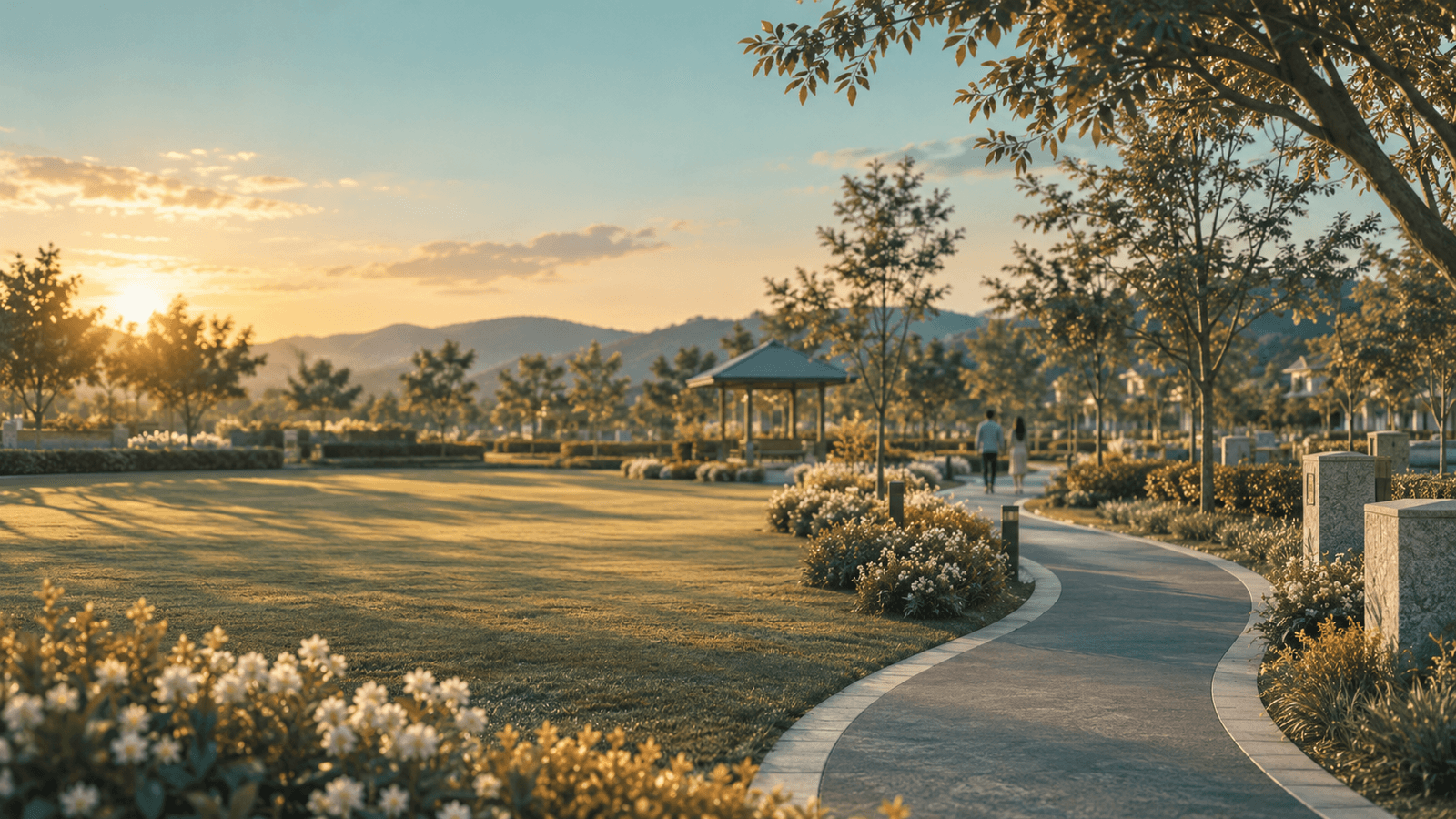
A corner plot usually gives you two road edges, more daylight and easier vehicle access. In return you may get more passing traffic, less privacy, a longer boundary to look after and a higher price. Whether the trade is worth it depends on how your household lives, so this guide sets out both sides and ends with a worksheet you can fill in on site.
What “corner plot” actually means
In a plotted layout, a corner plot sits at the junction of two roads. It has road frontage on two sides instead of one. Some corners sit at a four-way crossing, some at a T-junction, and some at the bend of an internal road. These are not the same, and the differences affect noise, traffic and how the plot can be used.
A regular plot, also called a middle or inside plot, has road access on one side and neighbouring plots on the rest. Most plots in any layout are regular plots.
Two things are worth settling early. First, check the corner on the sanctioned layout, not only on the sales plan, because the two can differ. Second, look at what each road is. A corner between a wide layout road and a narrow internal lane behaves very differently from a corner between two similar roads.
Where a corner plot helps
Light and ventilation
Two open sides mean more of the house can face outward. Windows on two walls can catch daylight and cross-breezes more easily, especially in rooms you use all day. A regular plot with neighbours on both sides can still be bright, but the side walls are often shared or close, so most light comes from the front and back.
This is a possibility, not a guarantee. The result depends on how the house is designed, how tall the neighbouring buildings become and which direction each road runs.
Two-road access and parking
With two frontages you can often choose where the gate goes. That can help with parking, with deliveries and with keeping the main entrance away from the busier road. Some owners add a second gate for a work area or a separate entrance. Check the sanctioned plan and the local rules before assuming any second opening is allowed.
A corner also gives more room to turn a vehicle in and out. On a regular plot with a narrow road, manoeuvring a car can be awkward, especially if neighbours park nearby.
Visibility and resale appeal
A corner house is easy to find and easy to see. Some buyers like that. Many sellers also price on the assumption that resale buyers will pay for it. Treat that as an expectation about buyers, not a promise about what any plot will fetch later.
Where a corner plot costs you
Privacy
Two road edges mean two sides from which people can see in. Passers-by, vehicles stopping at the junction and anyone using the second road all have a line of sight to your boundary wall or windows. You can manage this with wall design, planting and window placement, but those things cost money and take planning.
Noise and traffic
Junctions are where vehicles slow, turn, honk and sometimes pause. If either road becomes a through route as the layout fills up, the corner hears it first. A plot on a quiet internal lane may look calm during a weekday visit and feel different on a weekend or in the evening.
Setback implications
Setbacks are the open spaces a building must leave from the plot edges. A corner plot has road edges on two sides, so the sanctioned layout and the building rules may affect how much of the plot is buildable. The exact requirement depends on the sanctioned plan, the rules in force when you apply, and the road widths involved. We are not stating figures here because they vary and change.
What you can do is ask. Before you pay a premium for a corner, ask your architect to read the sanctioned layout and the current building rules for that plot, and to sketch what you could realistically build. A corner may also carry a corner treatment shown on the plan, so confirm the usable area against what you are paying for. For the physical side of this, our plot boundary and measurement checklist explains how to reconcile the documents with the markers on the ground.
Maintenance
A longer boundary means more wall, more painting, more frontage to keep clean and more drainage edge to watch. If the plot sits low relative to either road, water behaviour matters on two sides. Our guide on road levels, plot levels and drains lists the questions to settle before you fill or build.
Price premium
Corner plots are often priced above regular plots in the same layout. We are not quoting any percentage, because the premium depends on the layout, the roads and the seller. Our piece on what drives plot prices around Bibinagar explains how position within a layout is one of several factors.
The practical point is to ask for the premium to be shown separately, and then decide whether the two frontages are worth that amount to you. If you would not use the second road, you may be paying for something you will not use.
A note on vastu
Many families consider vastu when choosing a plot, and the views vary. Some practitioners put more weight on which direction the plot faces and where the entrance and main rooms sit than on whether the plot is a corner. Others treat particular corners differently. We are not taking a position here.
If vastu matters to you, take the specific plot number to a practitioner you trust and compare their view with the sanctioned plan. Our vastu guide for plots lists what experienced buyers tend to check. Decide your priorities in advance so a vastu preference and a budget limit do not collide at the last minute.
Corner plot or regular plot: side-by-side
| Factor | Corner plot (typical) | Regular plot (typical) |
|---|---|---|
| Road frontage | Two sides | One side |
| Light and cross-ventilation | More wall area open to the outside, subject to design | Mostly front and back |
| Gate and parking options | More choices, subject to rules | Fewer choices |
| Privacy | More exposure | Usually more shielded |
| Noise and traffic | Can be higher near junctions | Often calmer |
| Setbacks | Check the sanctioned plan; two road edges | Check the sanctioned plan |
| Boundary upkeep | Longer | Shorter |
| Price | Often priced at a premium | Usually the base rate |
“Typical” here means common tendencies, not rules. A well-planned regular plot on a good road can beat a poorly placed corner.
Questions to ask before you choose
On the sales side:
- Which plot number is this on the sanctioned layout, and where does it sit?
- How wide is each road next to the plot?
- Is the corner premium shown as a separate line item?
- Is any part of the plot affected by a splay, turning radius or utility corridor on the plan?
- Is the area I am paying for the same as the area I can build on?
On site:
- Is the corner at a through road or a dead end?
- How does the plot sit relative to both road levels?
- What do I hear at morning, evening and weekend visits?
- Where would the gate go, and could vehicles turn safely?
- What can I see from the plot, and what can others see into it?
Our site-visit checklist for plots walks through the broader inspection, and the piece on gated plotted communities explains how layout management can change daily life around a plot.
Buyer Fit Worksheet
Copy this into your notes. Score each line from 1 (not important) to 5 (very important) for your household, then note what the plot you are viewing actually offers.
| Question | My priority (1-5) | What this plot offers |
|---|---|---|
| Do I want windows on two sides of the house? | ||
| Do I need a choice of gate position or extra parking? | ||
| How much do I value privacy from the road? | ||
| How sensitive is my household to traffic noise? | ||
| Am I comfortable maintaining a longer boundary? | ||
| Does my architect confirm the buildable area on the sanctioned plan? | ||
| Is the corner premium itemised, and is it within my budget? | ||
| Do vastu or family preferences affect the choice? | ||
| Do I plan to live here or let the house out? |
How to read it: if your highest scores are for light, access and parking, a corner deserves a serious look. If they are for quiet, privacy and a lower price, a regular plot on a calm road may suit you better. Where the answers split, visit both types at different times of day before deciding.
What this does NOT mean
- This guide does not say a corner plot is a better or worse financial choice. It makes no claim about future prices or resale outcomes.
- “Typical” tendencies do not describe any specific plot. Layouts differ, and your plot’s position, roads and levels decide the real result.
- It is not legal, architectural or vastu advice. Setback rules, buildable area and gate permissions must be confirmed against the sanctioned plan and current rules with your architect or the relevant authority.
- A premium does not prove quality, and the absence of one does not prove a weaker plot.
Before any purchase, confirm the layout permit on BuildNow under Citizen Search, and check registration status on TG-RERA where the project is registered.
WhatsApp us at +91 6309-555-444 (https://wa.me/916309555444) to plan a site visit or ask for a project’s document set.