
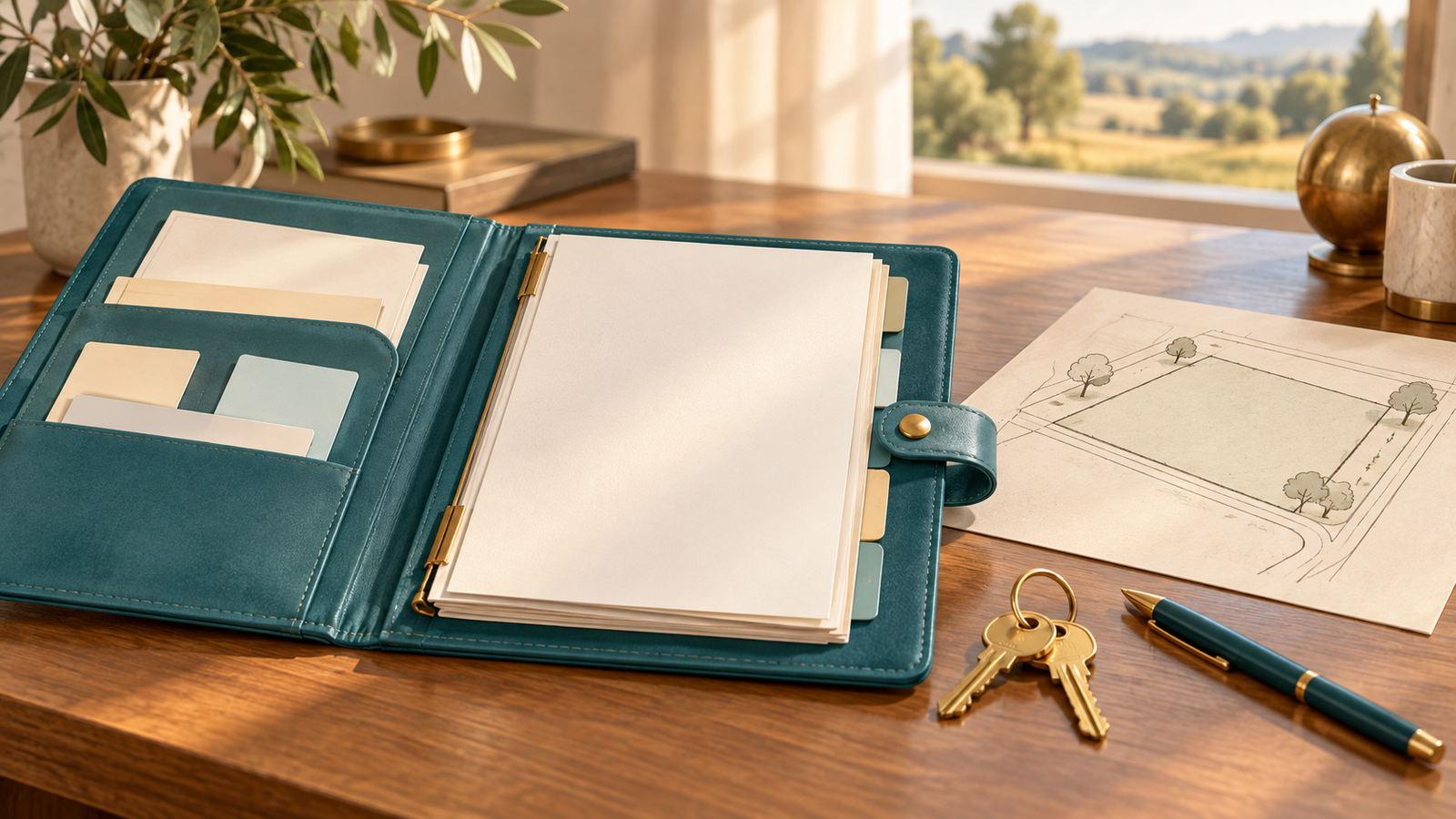
A future buyer’s first serious questions often arrive as a document request. Where is the registered deed? Which drawing identifies the plot? Why does an old receipt use a different reference? If answering means searching several phones and calling a former contact, start organising now.
Preparing for a possible resale does not commit you to selling. It gives you a retrievable file, a clear list of gaps and time to obtain professional advice before a transaction becomes urgent. It cannot guarantee demand, a particular price or a quick completion.
Use this plot resale documents checklist as preparation for that review, with the final requirements confirmed for your property.
Build a factual property index
Start with the identifiers used in your records: plot and layout references, village or locality, survey or subdivision details, and the registered-document reference. Write down where each comes from rather than relying on the description saved in a sales contact’s phone.
List the documents you hold and distinguish originals, certified copies, ordinary scans and informal correspondence. Add the date, source and custody location. If a file is incomplete or unreadable, mark it accordingly rather than counting it as available.
Our plot document verification guide helps identify the questions to bring to a property lawyer. A seller’s prepared index should make review easier, not replace the buyer’s independent checks.
Confirm where the originals are
Check the actual custody of important originals. They may be with you, in family storage or held elsewhere under an arrangement you need to document. Avoid writing “available” because you remember seeing a document at purchase.
For any original held by another person or organisation, record the custodian, acknowledgement and the process for arranging access or return. Where a lender is involved, obtain the relevant information directly from the lender and discuss the implications with your adviser before making commitments about delivery.
If an original cannot be located, get legal advice on the appropriate next steps. Do not assume that downloading a copy resolves every question arising from its absence. Telangana’s official MeeSeva service list includes certified copies of registration documents; confirm the appropriate service and its role in your circumstances. Telangana MeeSeva services directory.
Reconcile details before drafting a listing
Compare the identifiers and descriptions across the deed, available layout records, survey information and correspondence. Look for differences in plot numbers, dimensions, names, addresses and references to adjoining land.
Some differences may have an explanation, but record the explanation and its source. Others may require professional investigation or formal correction. Preserve the documents as issued and keep your observations in a separate discrepancy note.
Hypothetical example: an owner discovers that an old marketing sheet and the registered-document schedule describe the plot differently. The owner sends both to the property lawyer and requests a surveyor’s input where needed. The listing remains based on verified information while the disputed detail stays unresolved in the working file.
Do not silently replace the inconvenient document or edit its scan. The aim is an account of the property that another professional can follow.
Separate historical evidence from current verification
Keep the checks performed when you bought the plot, including their dates and scope. Then ask your lawyer what needs checking again before a proposed sale. An earlier search result should be labelled as an earlier search result, not described as a current clearance.
The Telangana state services portal lists an online encumbrance-certificate service. Have the appropriate adviser confirm the identifiers and search period relevant to your enquiry, and retain those details alongside any result. Telangana state services.
Our EC checking guide provides background for that discussion. Request professional interpretation of unexpected entries or inconsistencies rather than giving a prospective buyer an improvised explanation.
Apply the same discipline to project information. Where TG-RERA registration is relevant, the official project-search facility provides a route to check the exact project entry. Record the search date and reference; avoid applying a different phase’s information to your parcel. TG-RERA project search.
Our guide to approval, title and EC helps keep these different enquiries distinct.
Bring the ownership-period records into the file
Add relevant notices, correspondence, payment records and completed requests received since purchase. Identify anything pending: a correction, an unexplained balance, an unanswered query or a concern raised during a site visit.
For each issue, record the evidence, the responsible contact and the next action. Ask your adviser how it should be addressed and disclosed in a proposed transaction. Do not describe a matter as resolved because an agent expects it to be straightforward.
Include recent site information with dates. A maintenance record, survey report or photograph may help explain the current condition, but label its purpose and limitations. If a buyer requests a visit, use our site-visit checklist to organise access and observations without presenting photographs as title evidence.
Share a controlled pack
Prepare a working copy for professional review and a separate set of documents suitable for the stage of a buyer’s enquiry. Ask your lawyer which records should be provided, to whom and when. Avoid sending a full identity and property archive to an unverified contact simply because they ask quickly.
Keep a sharing log: recipient, purpose, files supplied, date and access arrangements. If you use restricted folder links, review permissions and remove access when no longer required. Preserve complete originals in your own archive even if a preliminary copy has information masked on professional advice.
Agree the process for inspection of originals separately. Any temporary handover should be documented with its purpose and acknowledgement. A casual broker visit should not become an unrecorded transfer of the whole file.
Plot Ownership Workbook: resale readiness register
Copy this table into your ownership file and complete it before commissioning the current legal review.
| Readiness area | What to record | Question to resolve |
|---|---|---|
| Parcel identity | Identifiers and the source of each | Do all records refer to the same parcel? |
| Original custody | Custodian, acknowledgement and access route | Can the relevant original be produced? |
| Document quality | Complete copy, date, source and missing pages | Which record needs retrieval or replacement? |
| Conflicting details | Both references and the precise difference | Who will explain or correct it? |
| Current verification | Adviser’s required checks and their scope | What needs a fresh search or review? |
| Ownership-period issues | Notices, receipts, requests and correspondence | What remains open? |
| Site condition | Dated observations and professional reports | Is any further visit or investigation needed? |
| Authorised sharing | Recipient, purpose, files and date | Is the disclosure appropriate and traceable? |
Give every open item a responsible person and a next follow-up. Once an answer arrives, attach the supporting record instead of deleting the history. Review the register again when you decide to sell, because readiness depends on the circumstances at that time.
For a Young India Housing plot, request available project records or arrange a site visit. Share the plot reference and the specific documents your adviser has requested so the enquiry can be answered clearly.