
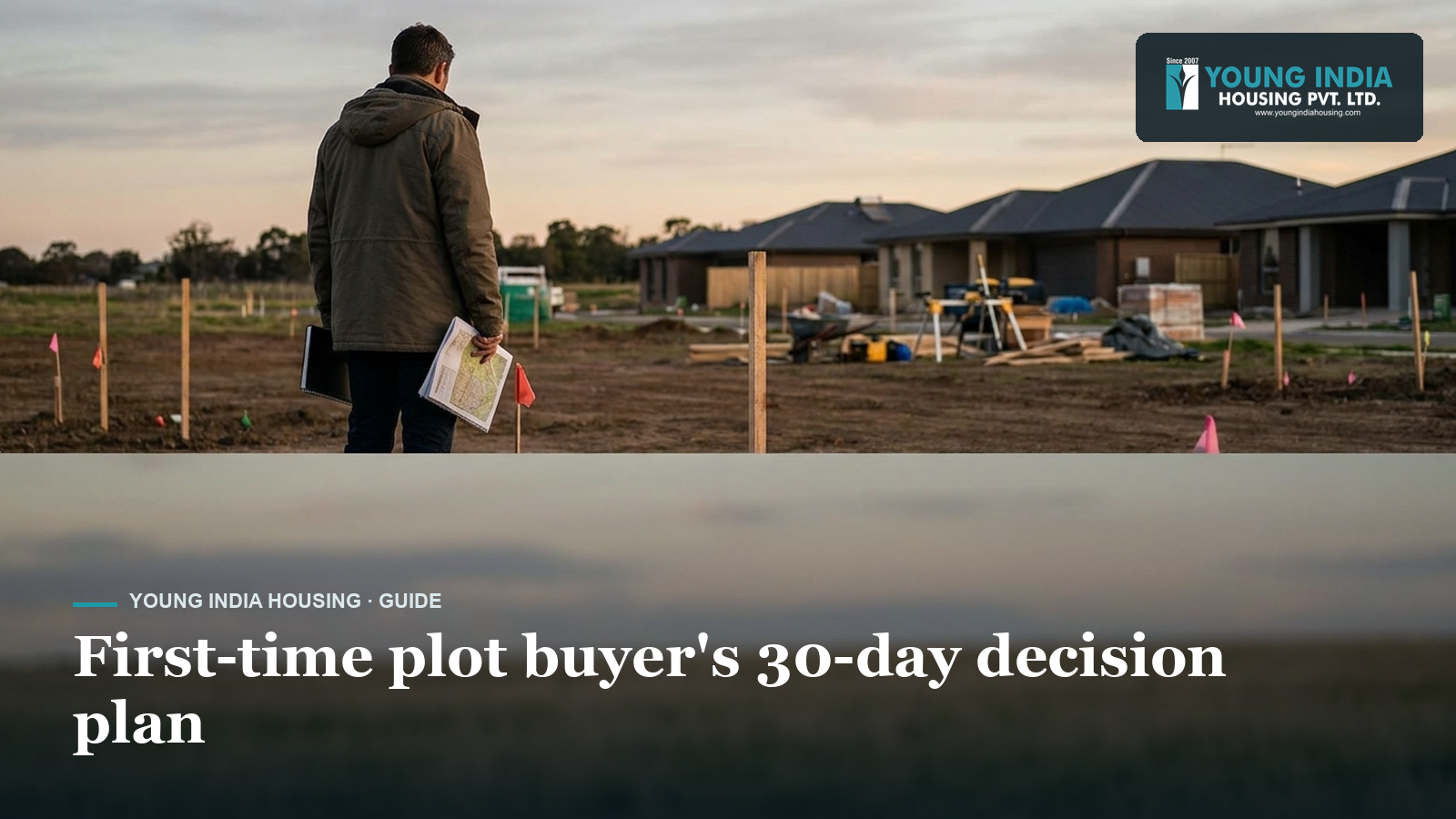
Buying your first plot of land feels bigger than almost any other purchase. It is the beginning of something permanent — a family home, a long-term investment, a foothold in a corridor you believe in. Because it feels important, it is easy to get paralysed by the number of things to check, or to rush in because a developer says availability is limited.
Neither approach serves you well. A steady, step-by-step process does.
This plan breaks the journey into four weeks. Each week has a clear goal and a short list of actions. By day 30, you will either have signed a sale agreement on a plot you are confident about — or you will know exactly why you need more time. Both outcomes are good ones.
Week 1 (Days 1–7): Define what you actually need
Before you visit a single site, spend a week getting your own requirements clear on paper.
Day 1–2: Set your budget ceiling — including the full cost.
The plot price is not your total outgoing. In Telangana, stamp duty and registration charges add approximately 7.5% of the registered value on top. Budget separately for legal fees (₹5,000–₹15,000 for an independent title review and agreement read), site-visit travel, and any immediate development costs if you plan to build. Your ceiling should reflect the total, not just the plot sticker price.
Day 3–4: Lock the corridor and plot size.
Decide the geography you want — and why. The Bibinagar–Yadadri corridor, the Ghatkesar–Pocharam belt, the Warangal Highway axis — each has a different price band, infrastructure stage, and travel time to your workplace. Look at the travel time from the project to your daily destinations on a weekday, not a Sunday morning. Also decide the minimum and maximum plot size you need. A 150 sq. yd. plot and a 400 sq. yd. plot are different investments and different construction propositions.
Day 5–7: Build a shortlist of 3–5 projects.
Search listing portals (99acres, MagicBricks, Housing.com) for your corridor and size range. Cross-check each result against the developer’s own project page. List the HMDA LP number or other approval reference shown for each project — you will use these in week two. Aim for 3–5 shortlisted projects. More than that spreads week two too thin. Fewer gives you no fallback if one fails verification.
Week 2 (Days 8–14): Run independent verification on each shortlisted project
This is the most important week in the plan. The checks here are the ones that protect you — and all of them are free, use public government portals, and can be done at home.
Day 8–9: Verify the layout approval status on the BuildNow portal.
Go to buildnow.telangana.gov.in — Telangana’s BuildNow portal, which now handles HMDA approvals — open Citizen Search, and search each LP number your shortlisted projects have published. For each one, confirm the status is active (not lapsed or under review), the sanctioned plot count matches what the developer is selling, and the survey numbers listed cover the project area. This takes under 15 minutes per project and is the single most important check a first-time buyer can do independently.
If a shortlisted project has no LP number shown anywhere — not on their website, not in their brochure, not when you ask the sales team directly — treat that as a serious question mark and move it down your list.
Day 10–11: Check TG-RERA registration for projects required to register.
Go to rera.telangana.gov.in and search by project name or registration number. Confirm the registration is active, the promoter name matches who is selling to you, and there are no complaint orders against this registration. Then do a second search: enter the developer’s company name and check whether any other projects by this promoter have complaint orders or revoked registrations. This takes under 10 minutes and tells you things the project-level search alone cannot.
Not every plotted layout in Telangana is required to be RERA-registered — projects below 500 sq. metres of development area are exempt. If a project is RERA-exempt, your title and EC verification become more important, not less.
Day 12–14: Request an Encumbrance Certificate for the survey numbers.
An EC (Encumbrance Certificate) records every registered transaction against a land parcel — sales, mortgages, court attachments. You want to see the developer’s acquisition and nothing registered after it.
Apply at a MeeSeva center or on the Telangana Registration and Stamps portal for the survey numbers the developer has disclosed. Ask for a minimum 13-year EC — it costs ₹200–₹500 and is issued within 2–7 working days. Initiate this application on day 12 and continue other steps while you wait.
Week 3 (Days 15–21): Visit the site and review documents
Week three is about converting the research into direct evidence. Bring your shortlist and your portal-check notes to every site visit.
Day 15–17: Book and do site visits — two in priority order.
Call the top two shortlisted developers and book site visits on weekdays if possible (so you see the access roads under normal traffic, not weekend conditions). When you visit:
- Bring the HMDA-sanctioned layout plan (the developer is required to share this — ask for it in advance).
- Walk the boundary. Match the road widths you see on the ground to the widths on the sanctioned plan.
- Ask to see the demarcation stones for the specific plot number being offered to you.
- Ask directly: which LP number covers the plot you are being shown? Is this plot number included in that LP?
- Note the condition of the approach road, internal roads, drainage, and electricity infrastructure.
The physical visit answers questions documents cannot: whether the roads you were promised in a brochure are real, whether the project area is accessible, and whether the on-site team treats your questions as reasonable rather than inconvenient.
Day 18–19: Request the developer’s documents kit.
After the site visit that went well, ask for the full documents kit: the LP certificate, the RERA filing where applicable, the sanctioned layout plan, and the EC for the survey numbers. A transparent developer sends this before you have paid anything. Read through the kit yourself, then share it with an independent property lawyer for a title-chain review. The lawyer’s job at this stage is to confirm that the ownership chain from original landowner to developer is clean, registered, and unbroken — and to flag any classified-land issues (assigned land, endowment land, poramboke) in the Dharani records.
Day 20–21: Receive and read your EC results.
By now the EC you applied for in week two should have arrived. Read it carefully:
- You want to see the developer’s acquisition deed and nothing after it.
- An active mortgage registered against the land is not disqualifying by itself — construction finance secured against project land is common in plotted development — but it must be discharged before or at registration, and the sale agreement must contain a binding, written commitment to that effect with a timeline.
Week 4 (Days 22–30): Review the sale agreement and decide
If you have reached week four, you have a preferred project with verified approvals, a clean (or explained) EC, a title-chain review from a lawyer, and direct site experience. This week is about the final document and the decision.
Day 22–26: Have your lawyer review the sale agreement before you sign.
The sale agreement is the document that protects you between signing and registration. Before signing, confirm:
- Your plot number, dimensions, and survey numbers match the sanctioned layout plan exactly.
- The abutting road width in the agreement matches the approved width for your specific plot.
- Any mortgage-discharge commitment specifies a deadline and mechanism — not just a general assurance.
- The entity signing as seller matches the applicant name in the HMDA LP record.
- There are no blank fields, open-ended timelines, or verbal additions outside the written text.
Your lawyer should return specific written notes within two to three working days. This session typically costs ₹3,000–₹8,000 and is the most valuable money you spend in the entire 30-day plan. With those notes, go back to the developer on the specific points. A good developer addresses legitimate document questions directly — you are asking for what was represented to be accurately reflected in the written agreement.
Day 27–30: Sign the agreement and pay the advance.
Once the agreement is final and your lawyer is satisfied, sign and pay the agreed advance. Keep signed originals (not just scans) of the agreement, the token receipt, and the documents kit. Mark your calendar for the registration timeline committed in the agreement.
The 30-day plan at a glance
| Week | Goal | Key actions |
|---|---|---|
| Week 1 | Define requirements | Set total budget, lock corridor + size, build shortlist of 3–5 projects |
| Week 2 | Independent verification | BuildNow LP check, TG-RERA check, apply for EC on survey numbers |
| Week 3 | Site and documents | Visit top two sites, request documents kit, engage lawyer for title review, receive EC |
| Week 4 | Agreement and decision | Lawyer reviews sale agreement, negotiate specifics, sign with correct documentation |
Two projects built for first-time buyers
Sai Enclave at Madhavapally near Bibinagar is designed specifically for first-time buyers — 76 clear-title open plots from 150 sq. yds., well-planned 30-40 ft internal roads, and a documents kit shared ahead of your site visit. The no-pressure approach means your visit is a verification exercise, not a closing pitch.
Eastern Meadows offers a larger planned-community experience in the same corridor — for first-time buyers who want the long-term value of a gated community alongside clear-title land ownership.
To request either project’s documents kit, WhatsApp our team at wa.me/916309555444 — mention the project name and we will send the kit the same day.
Take the plan with you
Download the First-Time Buyer Checklist — a one-page printable version of this 30-day plan with space to record your portal-check results and site-visit notes for each shortlisted project. WhatsApp “First-Time Buyer Checklist” to wa.me/916309555444 and we’ll send it across immediately.
Also read:
- 7 things to verify before any plot deal in Telangana
- How to verify a plot in Telangana before you pay token money
- HMDA vs RERA vs Title vs EC: what each document actually protects
- How to check an Encumbrance Certificate before a plot purchase
- Sai Enclave: affordable clear-title plots for first-time buyers near Bibinagar